


i’ve lost two physical homes in the last few years.
not in the poetic “home is where the heart is” sense. actual homes. places, routines, documents, objects, all the boring infrastructure around a life that you don’t really notice until you have to rebuild it somewhere else.
after the second forced move i started putting more and more effort into a different kind of home. one that could move with me and, ideally, wasn’t too dependent on a landlord, one particular company, one app, or whichever institution happened to have my documents that month.
most of it ended up being extremely unromantic: markdown files, an old MacBook Air, a private Discord server, scripts, backups, too many integrations and Promen — my personal agent — which by now knows a slightly uncomfortable amount about my life.
somewhere along the way it stopped being just a collection of tools i use and started becoming a layer around my life.
i’ve been calling it One Person State. the name is intentionally too grand. that’s part of the joke too.
from network state to one person state
this blog originally grew out of Future State, a series of events i organized in London, Lisbon, Berlin, Dubai and online. a lot of the conversations there were about the network state and adjacent ideas: people coordinating online, communities becoming less dependent on geography, new institutions, internet-native economies, all of that very future-shaped stuff.
then the much less future-shaped parts of life got so much louder.
immigration, money, family, bureaucracy. having to move. having to rebuild routines. learning that however distributed the future becomes, a passport office can still ruin your year perfectly well.
at some point a fairly obvious question appeared:
if i can’t organize one person, why the fuck am i thinking about organizing ten thousand?
so i zoomed in.

One Person State is basically my ongoing attempt to figure out how much of the administrative layer of my life can become easier to carry, inspect and change.
i don’t mean becoming self-sufficient. the One Person State has a surprisingly long dependency list: friends, cities, public infrastructure, companies, luck, people answering my messages, people inviting me places and a thousand other things i don’t control.
i still want to spend more time with people and i definitely don’t want to build a bunker with GPUs in it.
but there is a layer between “being alive” and “living your life” that is mostly admin: remembering things, following up, finding the right document, keeping track of small decisions, and not starting from zero every Monday.
that part felt increasingly automatable. or at least easier to manage.
what is actually inside it
the annoying answer is: a lot.
while working on this article i counted the files for the first time.
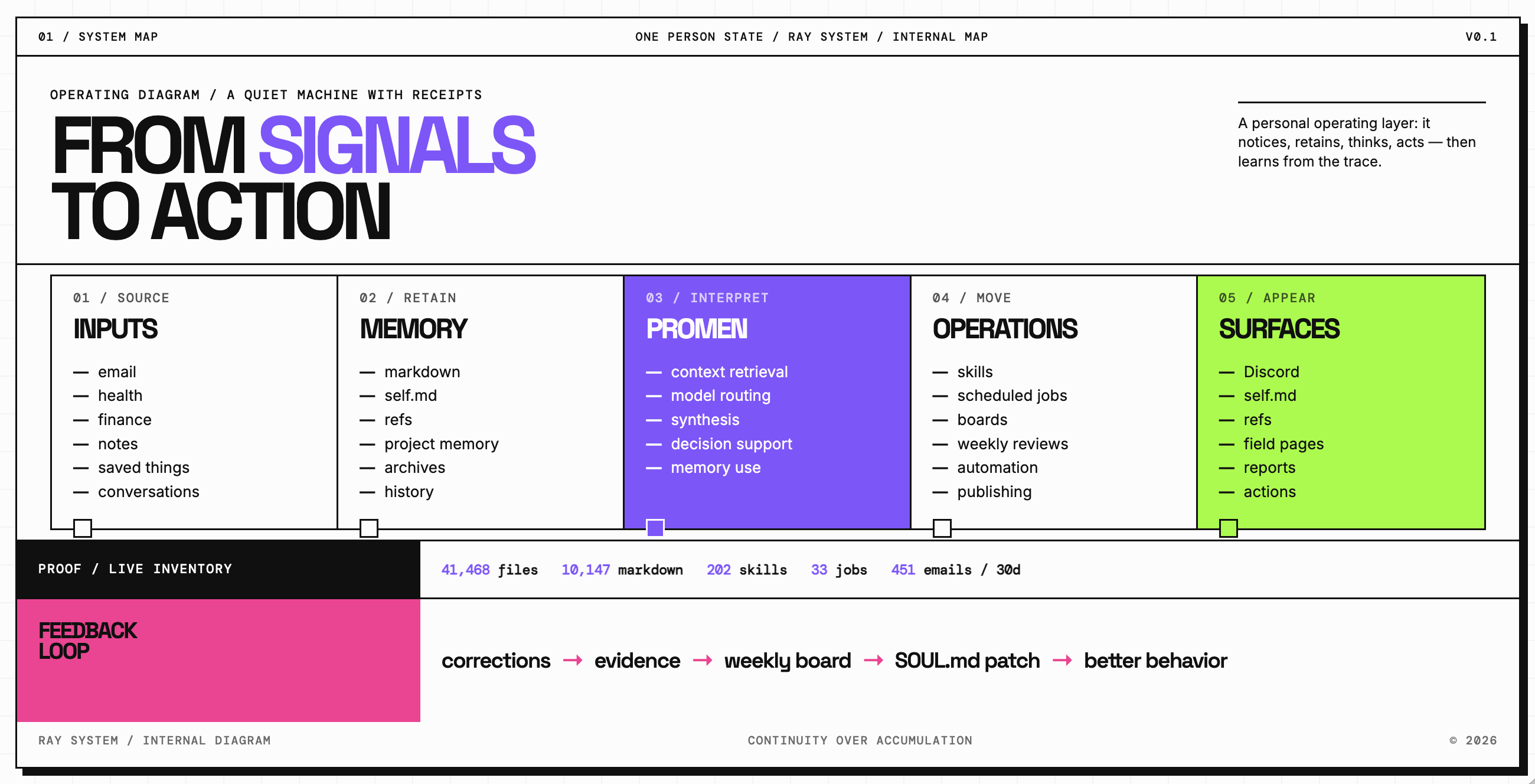
after excluding .git, node_modules, caches, exports, handoffs, build artifacts and other technical garbage, the working layer currently contains 41,468 files.
10,147 of them are markdown.
i’m not sure whether this proves that i built a personal operating system or that i have a problem. probably both.
most of those files are working notes, generated reports, research, project context, old artifacts, logs and things that should probably be deleted. one useful side effect of writing this article has actually been noticing how much shit had accumulated.
the architecture is much simpler than the file count makes it sound. signals come in from different parts of my life, some become memory, Promen does things with that context, and Discord is where i interact with most of it.
the physical layer
the main machine is an old M1 MacBook Air with 8 GB of RAM and 256 GB of storage.
it was already lying around at home as a backup laptop. now it stays on 24/7 and runs Promen on top of Hermes. my main MacBook and iPhone connect to it through Tailscale, so i can get to the same machine from basically anywhere.
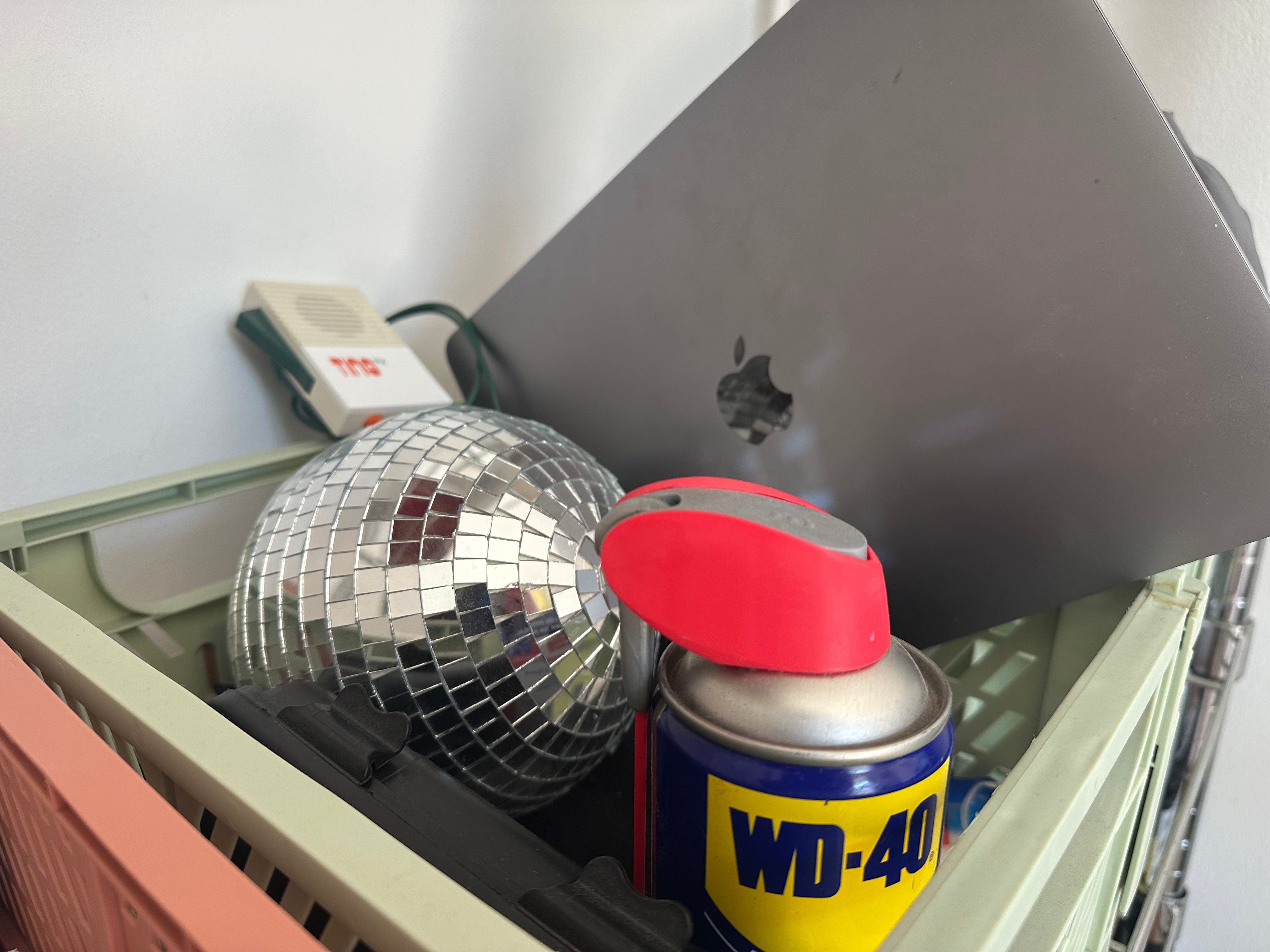
if i need to fix something visually, i screen-share into it. if i need something lower-level, i use SSH. sometimes i make Promen do unnecessary things like connect to Ableton through MCP, mostly because why not.
none of this is particularly advanced homelab engineering, but i like it.
i know where the files are and roughly what has to be restored if the machine dies.
the current recovery layer can bring a working Promen back on a clean Mac within a few hours. recovery for me increasingly means continuity: being able to lose the machine without losing the history of how i got there.
i want the full conversation history to be part of that too. if years of conversations are part of how Promen learned my projects, corrections and weird preferences, treating them as disposable chat history would be a pretty stupid backup strategy.
“local” is also an especially slippery word around AI.
the source of truth can live on my MacBook while selected context still goes to an external model. an API is still an API. moving files out of someone else’s SaaS database doesn’t mean no third party ever processes anything.
for me the important part is custody. i can replace the model without having to move my life with it.
the interface
most of the system lives behind a private Discord server.
people keep asking why i don’t use Telegram. mostly because Telegram already contains too much of my life. adding another layer of life administration there would be like putting a second kitchen inside the first kitchen because the first one is messy.
Discord gives me rooms.
the server has things like #health, #finance, #bureaucracy, #radar, #one-person-state, #dj, #shopping, #roles-radar and whatever else survived my latest cleanup. #dating has its own channel too. i’ve already said too much about that elsewhere.
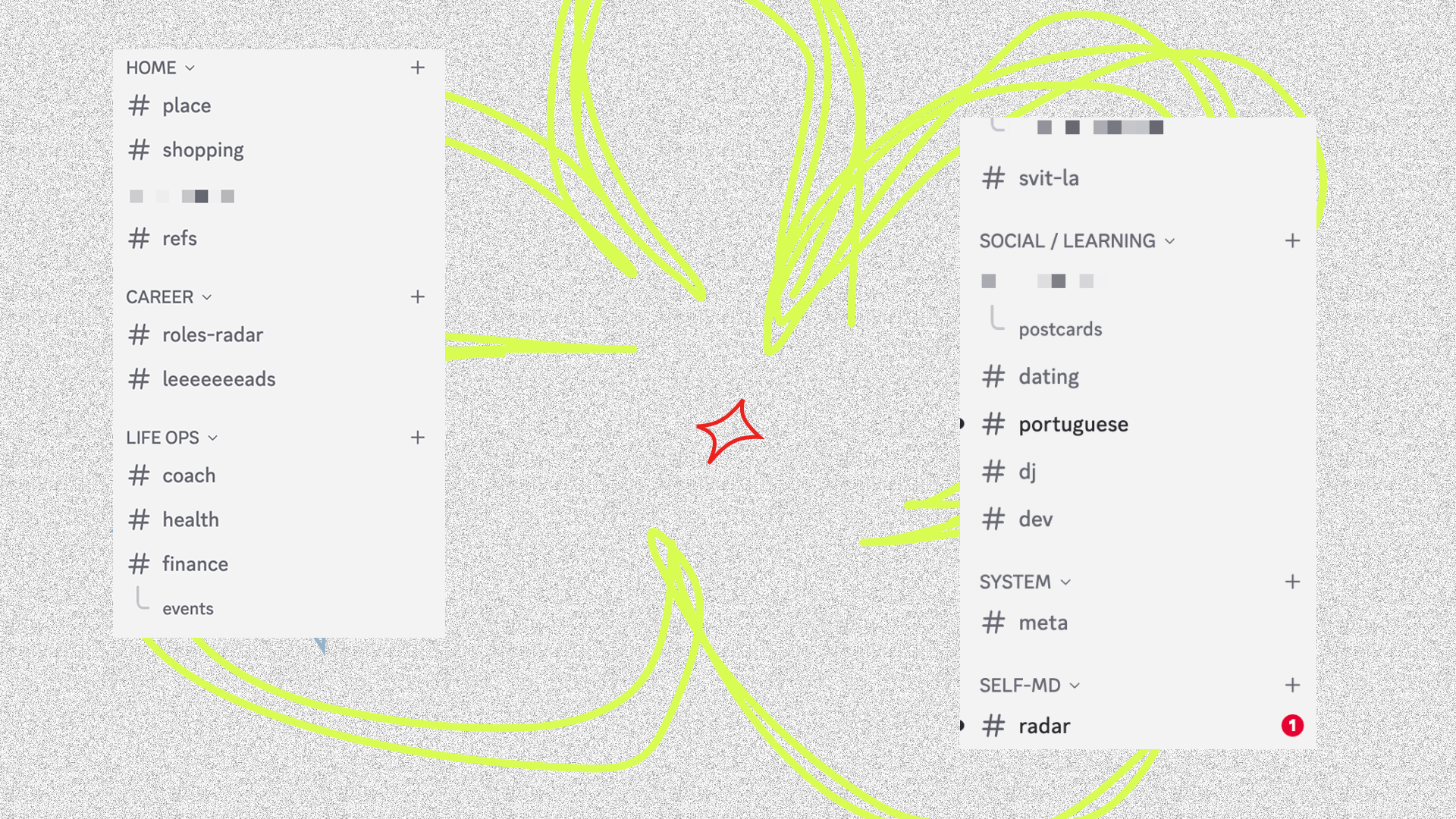
from outside it probably looks mildly insane. living inside it is not that dramatic. and the taxonomy isn’t sacred either — i change it all the time.
the useful part is having contextual boundaries. when i’m talking about health, i don’t need a giant chat history about a residence permit sitting in the same context. if something is temporary, i usually create a thread. if the thread is somehow still alive a month later, it has earned the right to become a channel.
Promen can still retain broader context across those areas, but every conversation doesn’t have to carry my entire life inside it.
i’ve somehow already infected at least three people with this idea. they built their own OpenClaw/Hermes setups after seeing mine — and all three ended up using Telegram.
so Discord is clearly not the point. that part is just my particular disease.
models come and go
the model changes.
right now GPT does a lot of the work, but i’ve used Claude, Kimi, Gemini and others too. one is better for code, another for research, another gets cheap enough to use for background jobs.
the important part is that none of them own the memory.
most of my context lives outside the model: projects, preferences, decisions, rules, history. so switching models doesn’t feel like starting over.
there is also a slower feedback loop i built — basically a weekly mastermind session for Promen.
every night it collects evidence from recent sessions: where i corrected it, what kept going wrong, what repeated. once a week, a board looks at one question:
what recurring mistake actually got in Ray’s way this week?
only if there is a clear pattern does it make one small change to ~/.hermes/SOUL.md.
so when i switch models, the accumulated relationship mostly stays there too. the new model gets the same context, rules and history of corrections.
this is also why i stopped caring much about the whole second-brain app category. i have nothing against Obsidian. i just don’t really care which app displays the markdown anymore.
i care whether Promen can actually use it.
i care whether the information can do something.
a note about my finances can sit in a folder forever, or it can show up in a Sunday review next to upcoming expenses, remind me what i decided last month, and make an uncomfortable spending pattern harder to ignore.
that’s much more interesting to me than having a perfectly organized second brain.
yes, i track myself
at the beginning of this year i had a few broad goals around clutter, money, shipping more things, getting my physical and mental base into better shape, relationships, and this whole personal OS experiment.
so a bunch of data started flowing into the system.
my Amazfit strap and smart scales feed Apple Health. DayFlow watches what i actually do on my computer and when. ZenMoney gives me a view of spending and runway. all of that gets exported to my server automatically every few hours.
a few times a week i also just dictate an audio note into the chat about how i’m feeling. what gave me energy, what annoyed me, what i’m avoiding, whether i’m tired, whether something keeps coming up.
bureaucracy has its own channel because i live in Portugal.
email gets watched too. one connected Gmail account alone received 451 incoming messages over the last 30 days. enough volume for an important administrative message to disappear between everything else.
Promen separates things that actually require me from things that can sit there: reply, act without replying, monitor, ignore.
in most cases i still keep consequential actions behind review. i do not particularly want my autonomous personal government freestyle-replying to immigration lawyers.
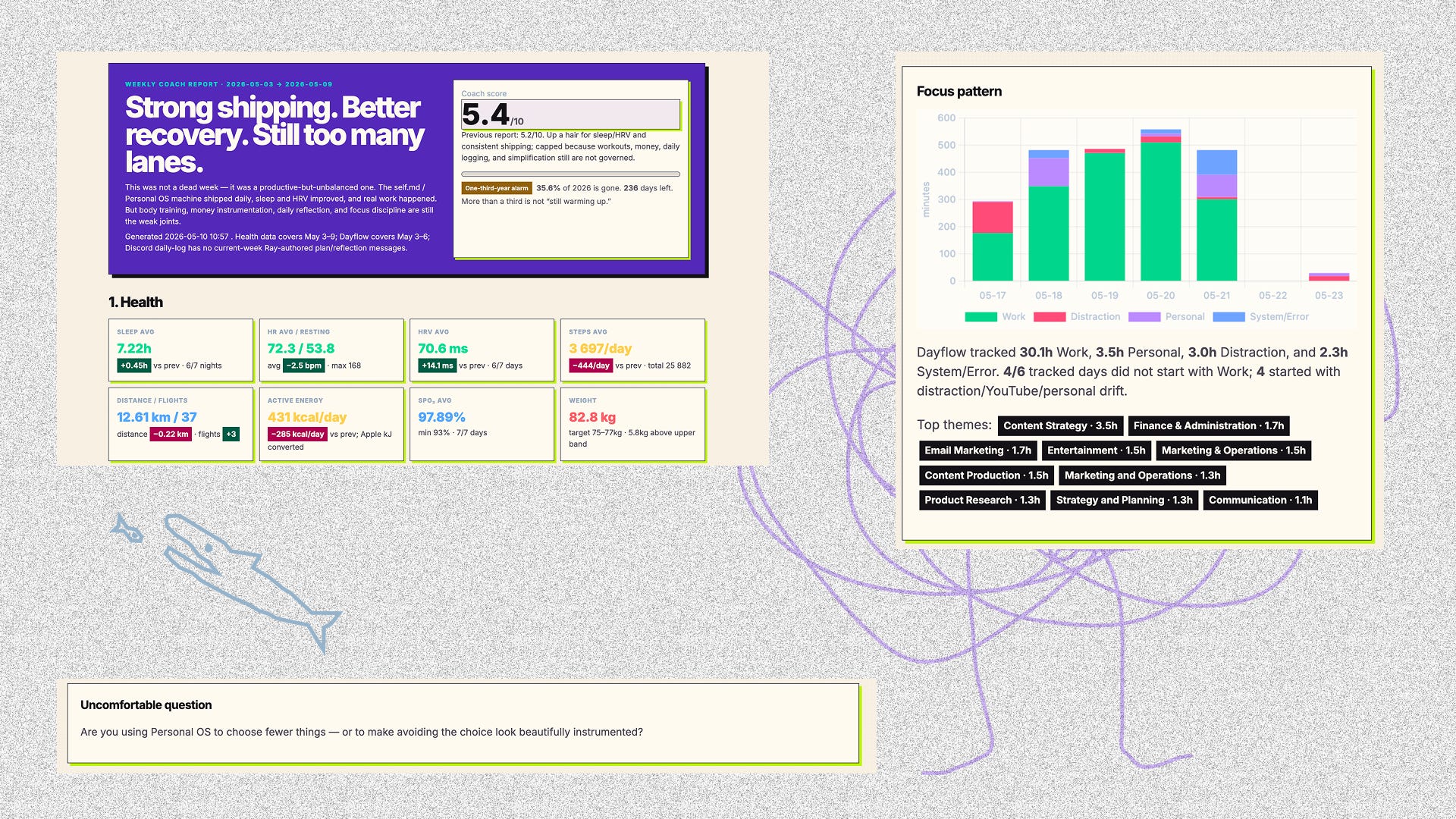
every Sunday these fragments get pulled together into a private weekly report: some graphics, some text, some bullet points. what moved, what didn’t, what i said i would do, what seems to keep happening, what data is missing.
DayFlow made it obvious that better work happened before the day filled with calls, so i moved calls after 15:00 where i could.
i probably could have figured this out without AI. it was just much harder to argue with the actual pattern.
that’s roughly my rule for tracking anything: if it doesn’t change a decision, i probably don’t need it.
civil service
the part i use most is probably skills and scheduled jobs.
a skill is basically a reusable way of doing something. sometimes it’s just a short instruction, sometimes it coordinates a bunch of tools.
right now Promen has access to 202 runtime skills in Hermes and 33 scheduled jobs.
over the last 90 days it recorded 442 Discord sessions and 4,292 background cron sessions. most of those background runs just check, prepare, monitor, or decide there’s nothing to do — which is what i want.
repeated behavior can slowly become infrastructure. if i keep doing the same thing or correcting the same output, i can turn that pattern into a skill instead of keeping it in my head.
one of those skills translates my russian drafts into the kind of English i actually use publicly. which is slightly recursive, since this article went through it too.
the downside is obvious: the system grows its own bureaucracy. while writing this article i found overlapping jobs, old skills for problems i no longer had, and rules that had simply outlived their purpose.
some got merged. some got deleted.
sooo even a one-person state needs occasional layoffs.
Radar
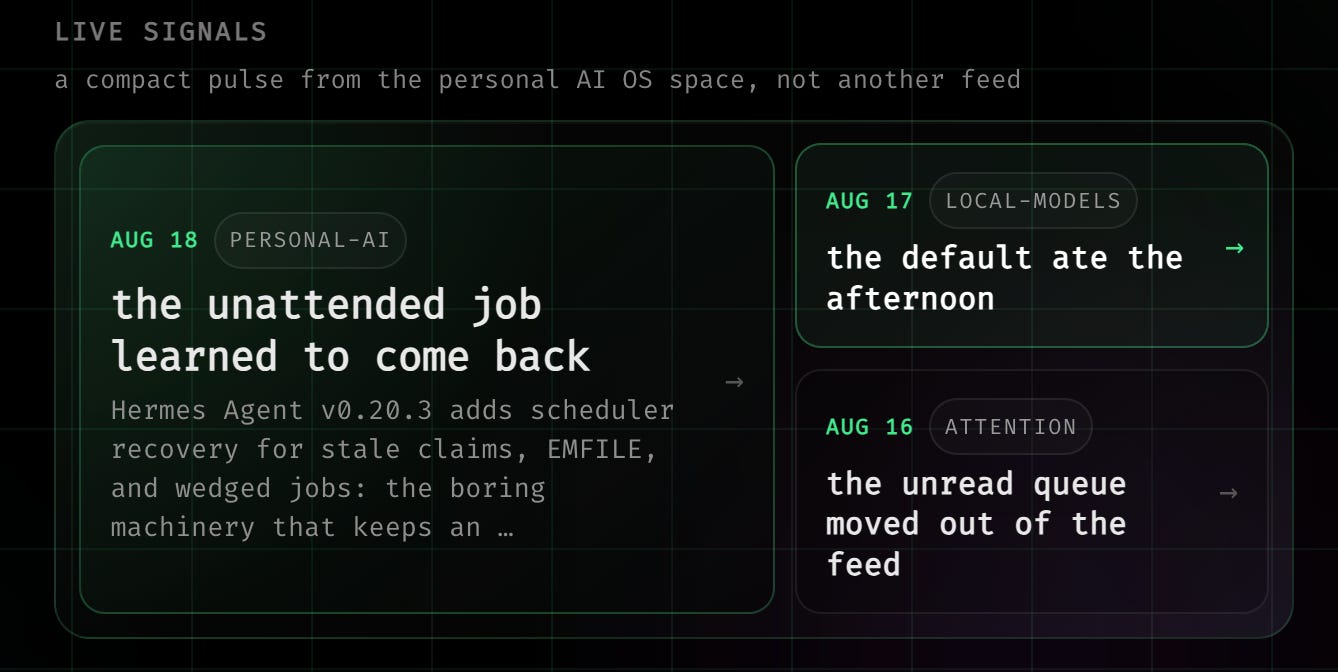
one of the larger systems is something called Radar, which runs the daily signals section on self.md
it watches 68 feeds, communities, searches and collection routes across Hacker News, Reddit, RSS, GitHub and YouTube, plus whatever i manually throw into it.
on August 10 it ended up with 274 unique candidates after de-duplication.
it published one.
every morning around 07:00 it does the research and writing pass. around 08:30 another job turns that into cards and posts everything to the site, X, Threads and Telegram.
since May 3 it has produced 106 daily carousel bundles.
it missed one day: May 27.
honestly, 106 out of 107 is good enough for a tiny media department living inside an old MacBook Air.
most days the machine spends 20–50 minutes researching, writing, checking assets and publishing the whole thing.
i spend roughly zero.
if this kind of weird personal infrastructure is your thing, you can subscribe. i’ll probably keep documenting it as it mutates.
my cabinet is a bunch of robots arguing with each other
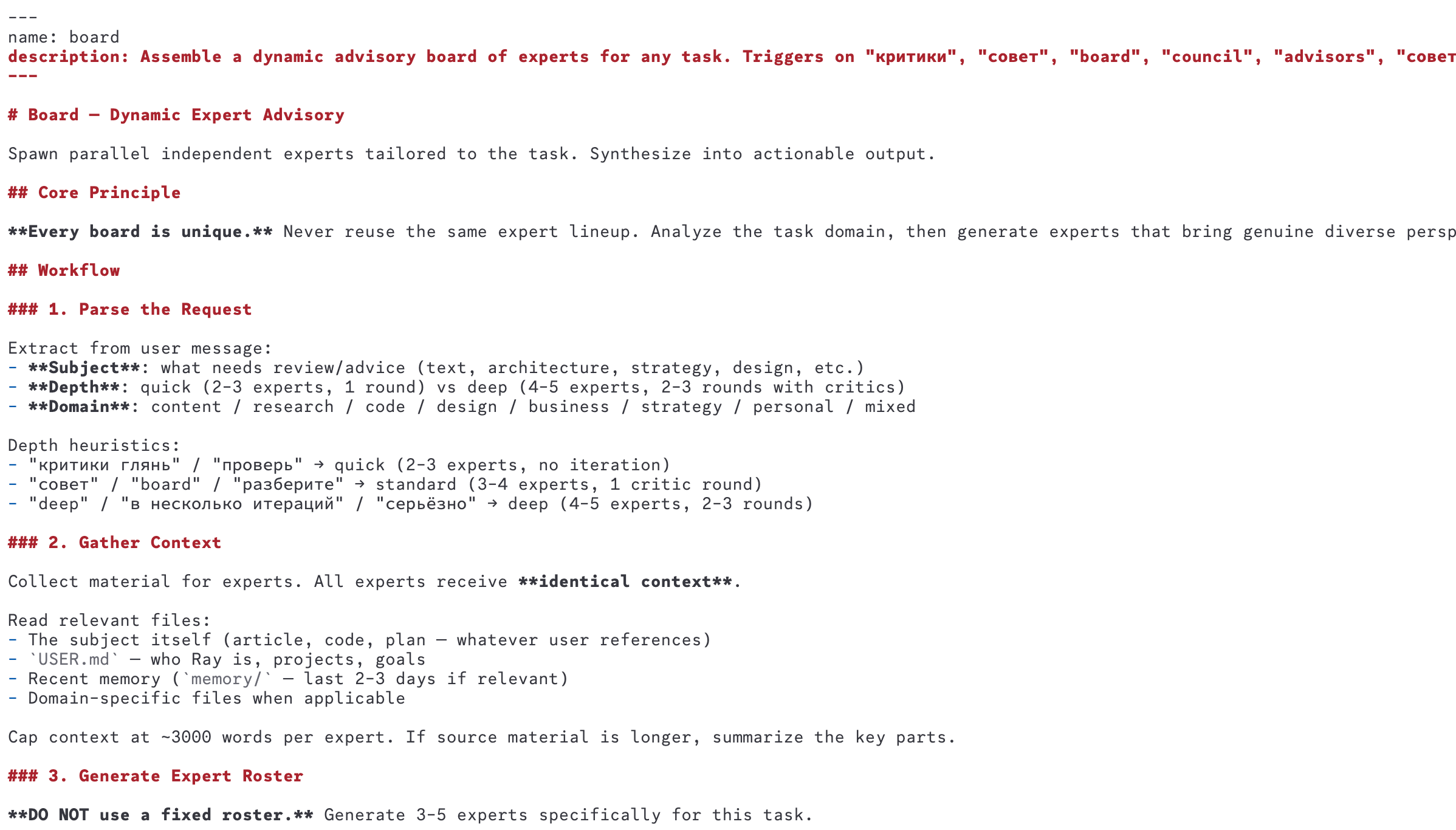
for harder problems, i use something i call board. some people call the same idea /council.
one polished answer can create a pretty good illusion of thinking, so i usually want disagreement instead.
Promen assembles 3–5 separate agents with different perspectives around the actual problem. sometimes those are roles — editor, skeptic, operator, whatever the task needs. sometimes they are reference lenses based on real people or thinkers whose way of looking at the problem might be useful.
they work separately first, then Promen compares where they agree, where they don’t, and usually runs another synthesis or red-team pass.
that’s basically it.
i use it for product decisions, writing, career questions and anything where the first reasonable answer is probably wrong.
and occasionally it produces very weird consequences.
the Illich test
one of the stranger examples is Ivan Illich.
while i was using the board around a product idea connected to self.md, one of the perspectives brought up an “Illich test”.
my first thought was basically: what Illich? Lenin?
not Lenin.
Ivan Illich.
i started reading the reasoning behind it, then reading Illich himself, and got pulled into questions about tools, autonomy, institutions, and what happens when systems built to help people start quietly reorganizing the people around the needs of the system.
which was uncomfortably relevant to someone who had already automated far too much of his own life.
i ended up writing a dead priest and your AI problem
that eventually led to a conversation with Sajay Samuel, an invitation to contribute more writing, and then to Thinking with Ivan Illich in Lucca in June.
then Promen helped me figure out how to get there.
my travel options are sometimes less trivial because of my passport, so it already had context around which routes and airlines tend to be less stupid for me. it also surfaced a train strike around the time i planned to arrive and suggested coming a day earlier.
none of this means Promen “got me invited to Tuscany”.
i wrote the article. Sajay read it. a real human contacted me. humans organized an event. i decided to go.
Promen could connect a fairly weird set of facts about me: what i had been reading, the kinds of ideas i keep coming back to, who had written to me, and which passport i travel with.
that’s what made the chain useful. not one clever answer, but context from different parts of my life showing up in the same decision.

accidental public tools
a slightly funny side effect of building all this for myself is that several pieces started escaping the One Person State entirely.
refs is one example.
i made it because i wanted somewhere to throw images, screenshots, websites, films, articles and other things i liked without thinking “which folder and which database field does this belong to”.
i send something to Promen, it figures out enough about the object to make it findable, and connects it to the rest of the collection.
that became refs.svit.la, and the code is also public on GitHub.
other people started using it too.
the design system went through a similar process.
i’m a pretty visual person and one thing that drove me insane with generated pages was having to explain my taste again every time. the result would be “good” in the generic AI landing-page sense, but it wouldn’t particularly feel like mine.
so i started making the design language explicit.
parts of it came from WAKA, a previous startup i worked on, and part of it was heavily inspired by The Designers Republic. over time it became the visual layer across my site, CVs, public tools and random little pages.
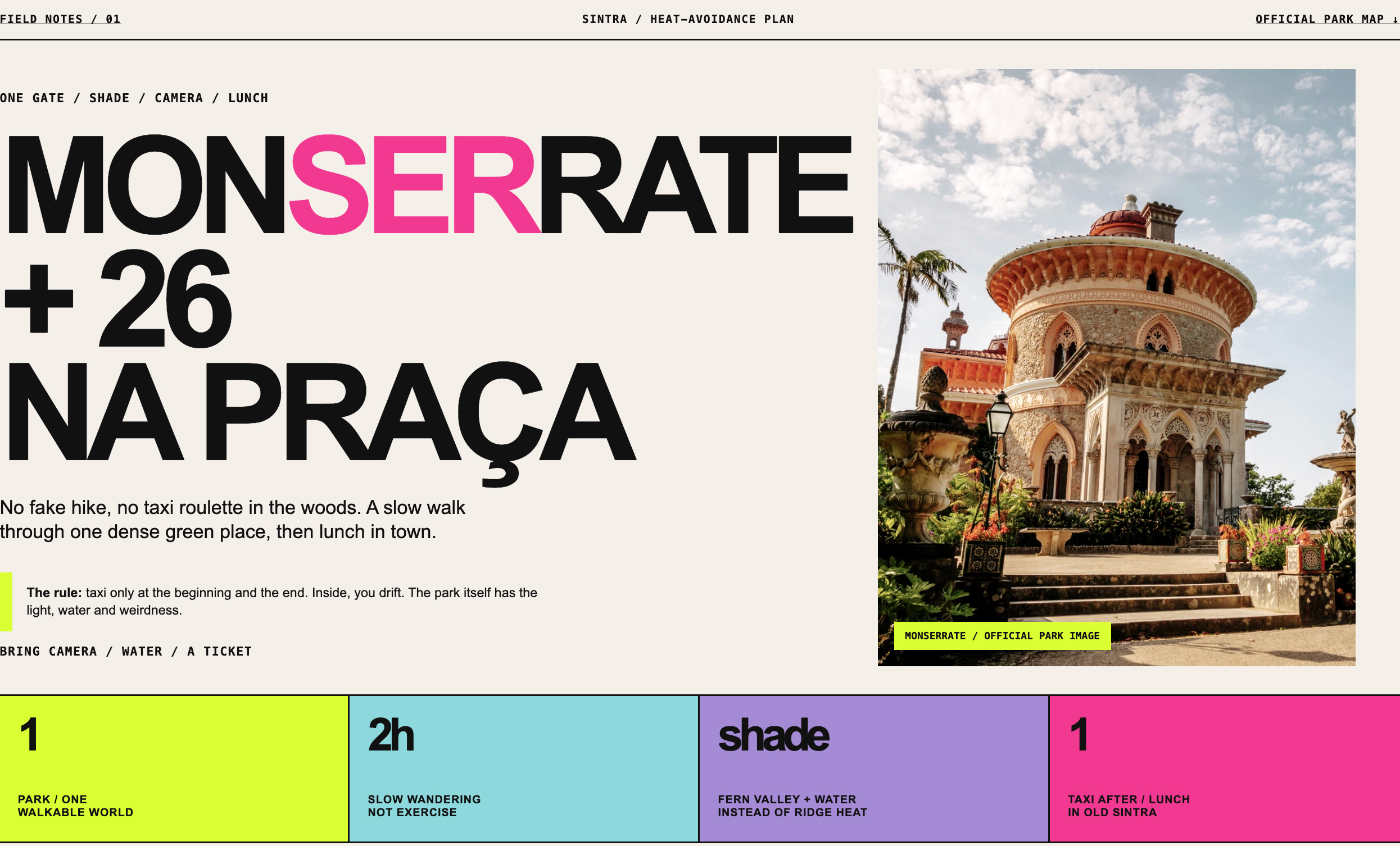
one weekend i told Promen what i wanted to do with my friend around Monserrate and it produced a tiny page using the same system. when she first saw it she assumed i’d found some unnecessarily fancy external travel site, which i took as a win because she is really-really good at design.
it was just field.svit.la/monserrate.
then there is the looksmaxxing skill, which is a much less serious example and therefore one of my favorites.
i originally made it because shopping for glasses online is a whole thing — anyone who’s tried knows. there was a discount that was too good to ignore, so i built the skill instead.
same with trying a new haircut: the kind of thing you can accidentally lose two hours to.
now it’s basically one prompt.
none of these began with “i should launch a product”. they just became useful enough that other people started using them too.

the multiplayer version
i’ve also started using versions of the same architecture with teams.
one recent example is Stay, a project i worked on.
instead of one person’s health, emails and personal projects, a similar setup sits across business systems: HubSpot, advertising platforms, brand guidelines, company knowledge and Slack.
this is not “the company has an AI chatbot”.
everyone has an AI chatbot.
the interesting difference is that the context no longer belongs to one person. several people can work in the same channels, see what others ask, reuse the same operating knowledge and interact with systems they may not know how to operate manually.
that starts looking much closer to institutional memory.
a marketer can ask about campaign performance without opening four dashboards. somebody can work with HubSpot without knowing every hidden corner of HubSpot. the system can connect information across sales, cohorts, creative work and previous conversations. and because this happens in shared channels (with some private boundaries of course), people also see what everyone else is asking instead of rebuilding the same context in twenty private chats.
this is also the direction i’m increasingly interested in professionally. if your company has five SaaS products, fourteen dashboards and a Slack full of people manually moving context between them, i’d genuinely like to talk
https://svit.la/
a One Person State is funny.
a twenty-person version starts looking suspiciously cool.

the creepy part
i have built an unusually detailed surveillance system and pointed it at myself.
a couple of weekends ago, my weekly report started giving me worse scores because i hadn’t been feeding it enough data. then it complained that i wasn’t wearing my Amazfit bracelet enough.
that was a slightly weird moment. some digital bureaucrat i built myself was now telling me what to wear and how much information it expected from me.
so naturally, i didn’t wear the bracelet for another week.
my first act of resistance against the One Person State was refusing to provide health data to my own government. i'm such a punk.

this is probably not for normal people
definitely not everybody needs this much infrastructure to have a functional life. probably including me.
sometimes the system solves a problem. sometimes it just gives my procrastination really great infrastructure.
building it is also part of the fun for me, which makes those two things annoyingly hard to separate.
i don’t think this is an operating system anymore
i used to call this a personal OS. i still do sometimes.
but “operating system” sounds more finished than this thing actually is.
it changes every week. things grow, overlap, break, get merged, get deleted. Hermes only became the main runtime in April, so i have no particular reason to believe this version is final either.
digital gardening is probably closer.
`self.md` is not a complete model of me, and i definitely don’t want it to become one. Promen is not me either. it’s just becoming increasingly useful infrastructure around me.
funny enough, the more boring stuff Promen takes off my plate, the more i end up thinking about the things it can’t really solve for me: home, belonging, relationships, what should stay untracked.
i don’t have very good answers yet. maybe that’s the next few articles.
i still don’t know how to build a network state.
i’m not even sure i want to anymore.
but after several years where large parts of my life depended on countries, landlords, visas, companies and other people’s servers, i like knowing that this part can move with me.
if the Mac dies, i can get Promen back in a few hours.
that feels like a decent place to start.
Ray Svitla // svit.la
stay evolving 🐌